Optimization is a success when the company gains, the customer gains, and employees work lighter - a conversation with Tomasz Wyszecki, head of process optimization and implementation at Aerosol Service
How do you define good optimization? What has to happen for you to say, "it was a success"?
A good optimization is one that realistically improves several areas simultaneously. It's more efficient production - shorter changeovers, less downtime, better machine utilization. It's also less waste: fewer rejects and rework, material and energy savings. Timeliness is also important - that the customer always receives his order on time.
And I'm not forgetting about work comfort - optimization should make people's daily tasks easier, reduce stress and increase safety. And finally: its effects must be sustainable, not temporary.
We have success when the company saves money, the customer is satisfied, and the worker on the shop floor says: "it's easier to work".
What is the process of implementing a new technology or machine - from idea to implementation?
It all starts with an idea - someone notices a need or an opportunity for improvement. It could be a suggestion from an operator, a maintenance technician or a proposal from a supplier.
If an idea seems valuable, we analyze it in terms of costs and benefits. We check whether we will gain efficiency, quality, savings or increased safety. When the balance comes out in favor, we prepare an investment proposal and present it to the Board of Directors for approval.
Once approved, the preparation stage begins: choosing a supplier, testing with the manufacturer, planning the assembly and checking what needs to be prepared on the shop floor. When the machine arrives, it undergoes further tests, and in parallel we conduct training for the team.
Then comes the moment of commissioning - the first trials, gradually increasing production and fine-tuning the settings. At the end we evaluate the results and compare them with the assumptions. If everything agrees, we can talk about a successful implementation.
What do you most often have to deal with - people, technology or time?
In our department, we measure ourselves against all these factors simultaneously.
People are the greatest strength, but also a challenge. New technology means a change in habits, the need to learn, and sometimes resistance to automation and implementation of changes. Good training and team involvement are key.
Technology has a learning curve - it needs to be adapted to the process, to anticipate limitations or failures. What looks good in theory often needs refinement in practice.
Time is a factor that is always in short supply. Assembly and testing have to be reconciled with ongoing production, and on top of that there are delivery deadlines and pressure to see results as soon as possible.
The trick is to find a balance between the three elements.
How do optimizations affect the daily work of other departments?
The effects can be seen very quickly. Production experiences less downtime and simpler operation, maintenance experiences fewer breakdowns and better predictability of services. Logistics and warehousing gain more stable material flow planning, and quality control gains fewer complaints and simpler parameter monitoring.
Any optimization, even a local one, ultimately improves the experience of the entire chain - from material supply to the finished product.
You work with many departments. What does your daily work look like with production, R&D or quality control?
You could say it's a well-knit puzzle. Production is our first partner - we are close to operators and leaders, supporting them in solving problems and testing new solutions. Research and Development brings ideas and new technologies, and we help translate them into production practice. Quality control gives us feedback on whether the process is working properly. It lets us know that optimization increases productivity without sacrificing quality.
Production says what it needs, R&D gives designs, quality control keeps an eye on parameters - and we tie it all together.
You have a team under you. What is most important to you in a leadership role?
The most important thing is the people. It is their energy and ideas that drive all changes. I value my team for their commitment, willingness to learn and share knowledge, but also their courage to propose improvements. Equally important is their discipline and responsibility - this is what keeps projects moving forward.
I see tremendous value in being able to support each other and work together to find solutions instead of excuses.
What technology trends in manufacturing do you see as the most promising today?
No doubt automation and robotization.
Robots and automated lines increase efficiency, cut costs, reduce errors and waste. They solve the problem of labor shortages in heavy or repetitive tasks, while guaranteeing repeatable quality.
Modern systems are also flexible - they can be quickly adapted to new products, improve safety and ergonomics.
Therefore, automation is not just a trend, but a strategic investment that will determine the competitive advantage of companies in the coming years.
See other news
See other articles
Read on our blog

Aerosol Service is ISO 14001:2015 certified – a testament to the highest standards of environmental management
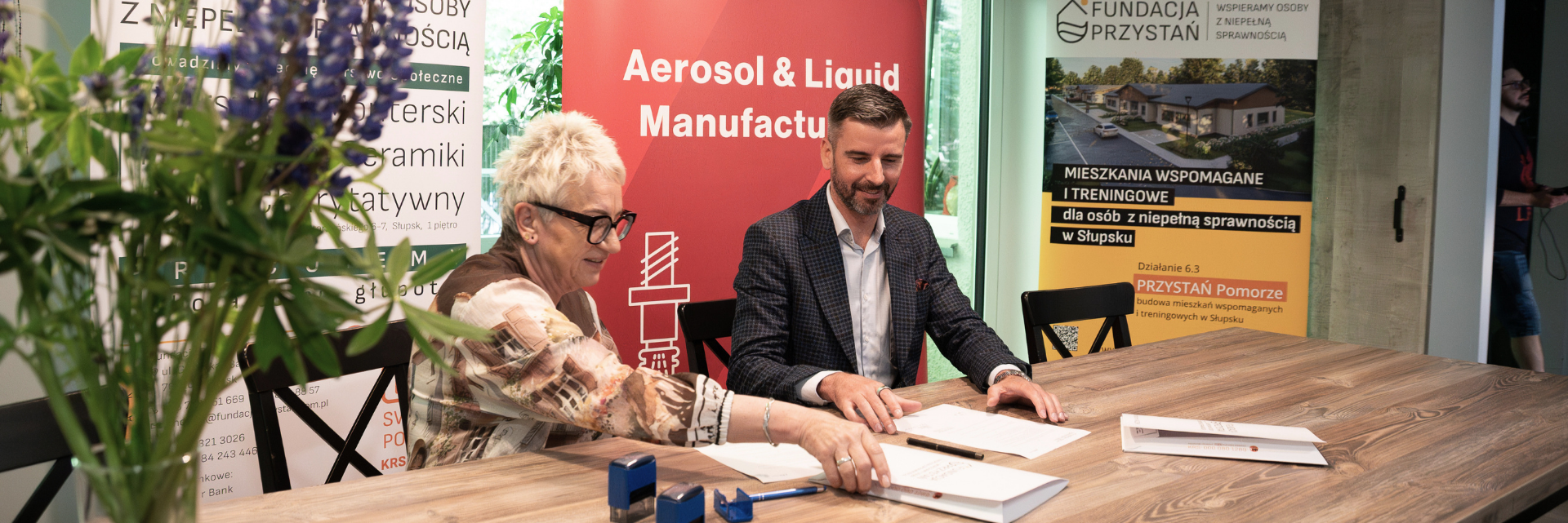
Aerosol Service is a Patron of the Przystań Foundation