Product safety is the foundation: an interview with Milena Nowosielska- Quality Management System Supervisor at Aerosol Service
What does "product safety" mean to Aerosol Service and how do you define it in practice?
Milena Nowosielska-Dasyuk: For us, product safety is not just about meeting standards - it's an organizational culture. As part of our Quality Policy, we promote a product safety culture at every level of the company, based on shared values, attitudes and principles. This approach is integral to the entire organization.
Which elements of a quality management system are key from the perspective of cosmetic and household chemical product safety?
Our operations are based on ISO 22716, IFS HPC and ISO 9001 standards. Their integration allows us to manage all key processes - from production to quality control to monitoring. In addition, we use GMP, GHP and a hazard analysis system. This is a solid foundation for our comprehensive approach.
What are the most common security requirements of contract customers?
Customers increasingly expect guarantees of safety and quality at the highest level. For them, our certifications and audit results are confirmation that they can trust us. Daily attention to product quality translates into partner satisfaction and loyalty.
What role do external audits such as IFS HPC or COSMOS play?
Audits are not just a requirement - they are a way to verify and raise standards. High scores in IFS HPC are evidence of our commitment to quality, as well as building customer trust. COSMOS and Ecocert certification underscore our sustainability and transparency efforts.
What is the preparation for audits and which aspects are the most difficult from a product safety perspective?
Honestly? We don't see it as a difficulty. We have an implemented, functioning system and trained personnel. Our daily work in the GMP and GHP standard, as well as systematic training and documentation, allow us to treat auditing as a natural part of the business.
What oversight mechanisms do you employ to prevent risks at the design and production stages?
Processes are monitored right from the formulation stage. We conduct hazard analysis, assess risks, implement control measures and critical control points (CCPs). All data is documented and regularly reviewed, allowing us to react quickly.
How do you vet and qualify suppliers for security?
The supplier qualification process is a multi-stage one. We analyze their organizational capabilities, quality systems, environmental impact, conduct audits, and they fill out verification questionnaires. This helps ensure the continuity and safety of raw materials and packaging.
What is the importance of traceability and documentation?
Thanks to the ERP system, we have full traceability - we know where the raw materials came from and where the product went. Every stage of production is documented. This is crucial not only for audits, but also in case of a quick recall.
Do you implement preventive measures and risk monitoring systems?
Definitely yes. Our risk management system includes analysis of risks at every stage - from supply to finished product. The risk team consists of specialists from various departments, supported by management. We use tools such as risk matrices, FMEA and HACCP.
What new challenges are you seeing in terms of the safety of cosmetics and organic products?
The growing interest in natural products is forcing not only changes in formulations, but also a more difficult selection of raw materials and the development of effective but safe formulas. ECOCERT and COSMOS are the answer to these needs, although it takes a lot of commitment to meet them.
What measures do you plan to implement to further develop product safety?
We want to bet on risk reviews, internal audits, engaging staff and strengthening the quality culture. Educating employees - including through initiatives such as an art contest for children - is paramount to building safety awareness.
See other news
See other articles
Read on our blog

Aerosol Service is ISO 14001:2015 certified – a testament to the highest standards of environmental management
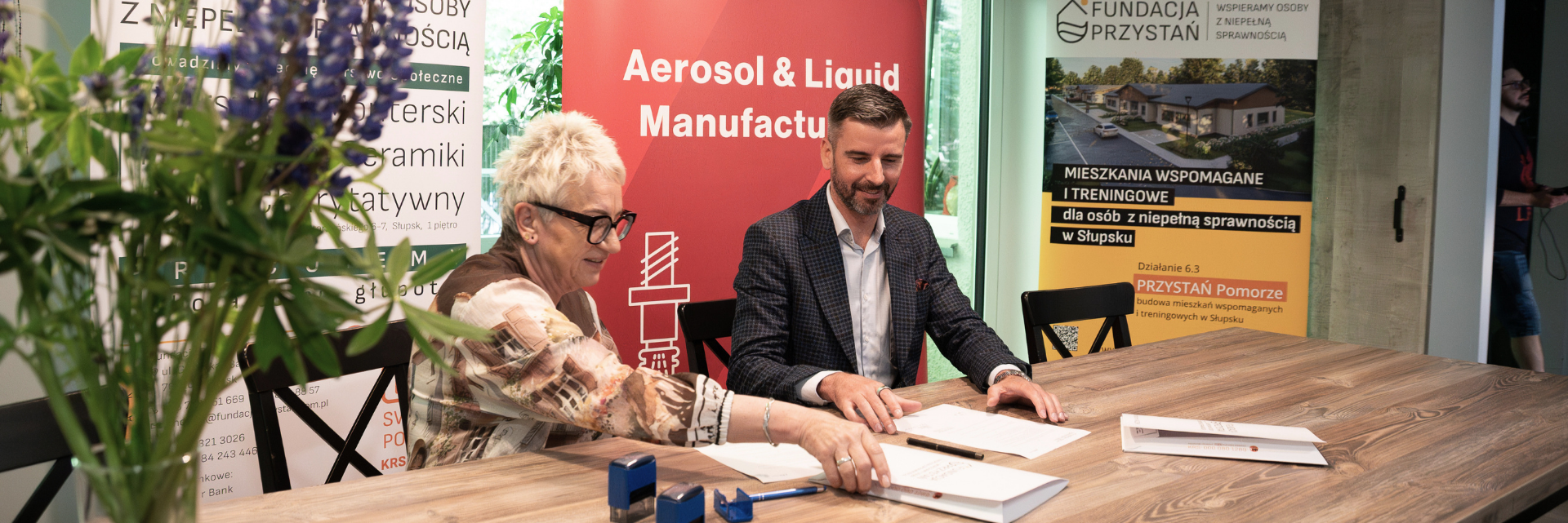
Aerosol Service is a Patron of the Przystań Foundation