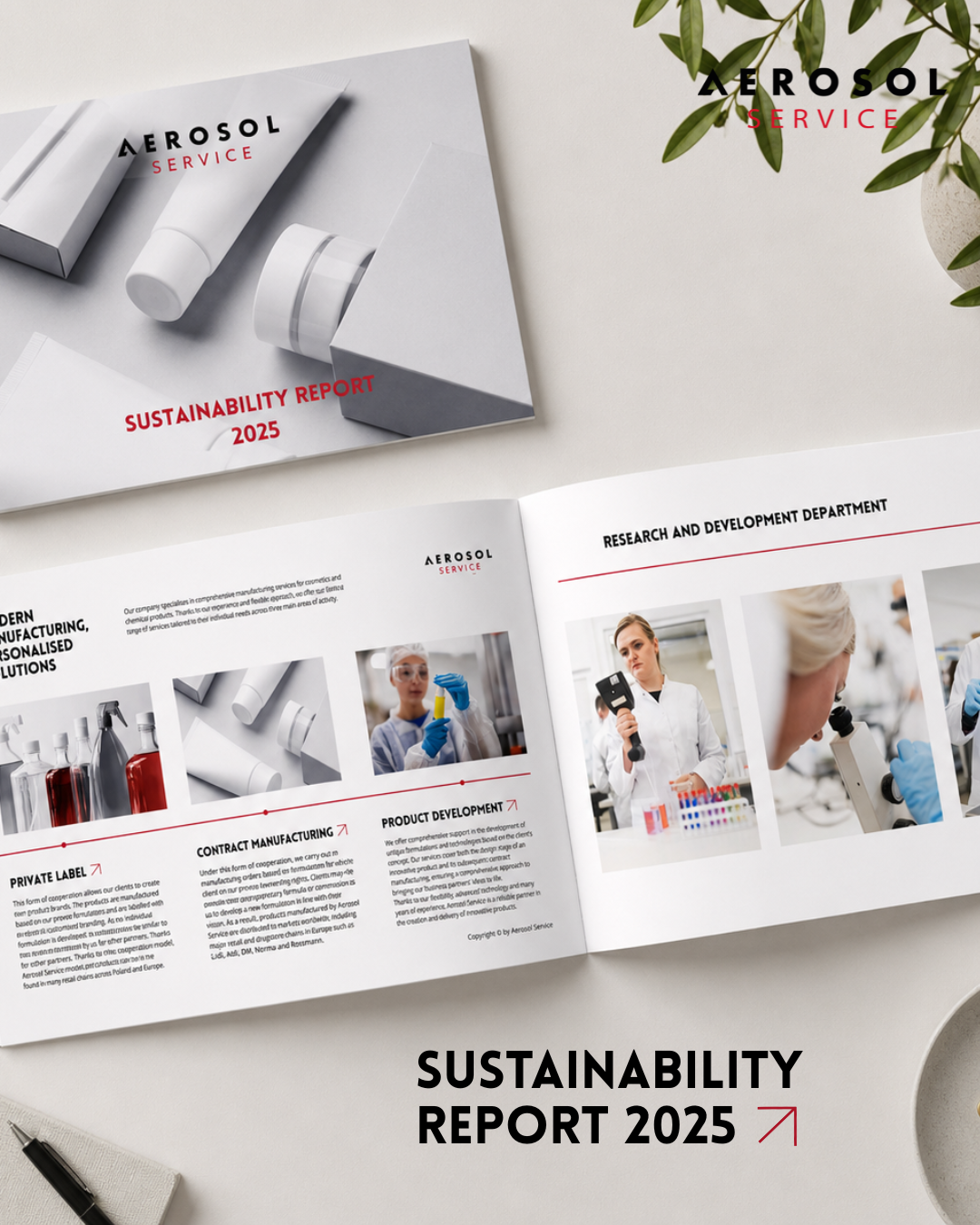
Technology, partnership, and responsibility – how Aerosol Service is redefining contract manufacturing in the beauty and personal care sector
This interview with Damian Piotrowski, CEO of Aerosol Service, was published in World Aerosolsmagazine, March–April 2026 issue.
Our main goal at Cosmoprof is to strengthen relationships with existing partners and establish contacts with new brands that are looking for an experienced and flexible contract manufacturer. You can find us in the contract manufacturers' area – Cosmopack, Pavilion 19, stand M18.
For us, trade fairs of this type are primarily a platform for direct, substantive meetings. We arrange meetings with our customers in advance to discuss the development of current projects, new implementations, and directions for further cooperation. Key Account Managers, Project Managers, and members of the management board are present at the stand, so that both current and potential partners can immediately obtain detailed information about our production capacity, cooperation model, and technological capabilities.
During the fair, we present the full spectrum of our expertise – both in the area of aerosol and non-aerosol products. We have large production capacities and a wide portfolio of solutions covering various cosmetic categories. We offer the possibility of filling many types of packaging, not only aerosol containers, but also bottles, jars, tubes, doy packs, and individual solutions. Our advantage is our production flexibility and ability to implement projects of varying degrees of complexity – from standard formulations to more demanding, innovative solutions.
Brands are increasingly looking not only for production capacity, but above all for a technology partner that can provide flexibility, security, speed of implementation, and regulatory support.
The first clear trend is the continued growth in the importance of specialist and problem-solution-driven products – this applies to cosmetics, trichological products, cosmetics for sensitive skin, and protective preparations, among others. Aerosols as a form of application are seen here as a hygienic, precise, and convenient solution.
The second important trend is the development of "clean" formats and simplified formulations. Manufacturers expect shorter ingredient lists, transparent communication, and raw materials with proven safety. At the same time, there is growing interest in propellants with a lower environmental footprint and packaging solutions that fit in with brands' ESG strategies.
Another trend is premiumization and user experience. Spray quality, foam or mist consistency, application ergonomics, and formulation compatibility with modern valve and actuator systems play a major role. Brands are increasingly treating aerosol technology as an element that builds a product's competitive advantage.
From a contract manufacturer's perspective, we are also seeing greater momentum in shorter production runs and faster market launches. Brands are testing new categories and product lines in a pilot model and then scaling up their projects. This requires a high degree of operational flexibility and efficient R&D capabilities from the manufacturer.
We have recently significantly expanded our portfolio of SPF products, both in the form of classic aerosols and lighter protective mists. We are seeing growing interest in this type of product in various price segments, which is why we are focusing on stable, safe formulations and compatibility with the appropriate dispensing systems.
Another important direction is the development of products in BOV (Bag-on-Valve) packaging. This technology allows the product to be separated from the propellant, which translates into higher formulation purity, the possibility of using fewer preservatives, application in any position, and very precise dosing. In addition, this solution allows the use of compressed air or nitrogen as a propellant gas, which meets the expectations of brands in terms of safety and sustainability.
In the haircare segment, we are developing, among other things, dry shampoos and texturizing sprays – categories that continue to show high growth. Here, we focus on performance parameters such as spray quality, no visible residue on the hair, and appropriate spray characteristics.
At the same time, we are working on several innovative solutions that we are co-creating with our partners. Due to the nature of our contract work, we cannot disclose any details before their official launch. In our industry, loyalty, confidentiality, and protection of customer know-how are of key importance—they are the foundation of long-term cooperation.
Sustainable development is becoming increasingly important in cosmetics – what measures is Aerosol Service taking in terms of propellant selection, use of recycled materials, and carbon footprint reduction?
Sustainable development is one of the key directions for the entire cosmetics industry today, and at Aerosol Service we treat this area as a real commitment, not just a market trend.
For two years, we have been publishing an ESG report in which we transparently present data on our operations and the measures we are taking to reduce our environmental impact. This is an important tool for us, both in terms of responsible management and building credibility with our customers and partners.
In the field of propellants and aerosol technology, we support solutions that reduce environmental impact, including through the development of Bag-on-Valve products and the use of compressed gases where technologically justified.
At the same time, packaging materials are playing an increasingly important role—we are seeing growing interest in cans and components containing recycled materials, as well as projects aimed at reducing packaging weight and improving its circularity.
In 2026, we also anticipate a number of investments that will significantly reduce the carbon footprint of our operations. We are focusing on solutions that increase energy efficiency and further optimize production processes.
Equally important, in our daily cooperation with customers, we actively recommend a more sustainable approach—both in terms of packaging selection and ingredients or application technology. Our role as a contract manufacturer and R&D partner is not only to implement the project, but also to support brands in making informed decisions that respond to consumer expectations and environmental regulations.
We see sustainable development as a long-term process that requires consistency, investment, and cooperation across the entire value chain—and that is precisely the direction we are heading in.
As a contract manufacturer and R&D partner, how do you work with cosmetic brands to develop products from concept to market launch?
At Aerosol Service, we guide cosmetic brands through the entire product development process – from concept to market launch. We begin our collaboration with the product concept, then develop the formulation, select the appropriate packaging, and prepare samples. The next stage involves testing and comprehensive technical and regulatory support to ensure product safety and compliance with market requirements. The whole process ends with the launch of industrial-scale production, allowing customers to efficiently move from idea to finished product on the shelf.
What opportunities do you see for aerosol technology in new, emerging beauty categories or application methods that have not traditionally used aerosols?
Today, aerosol technology has a much broader potential than the traditional categories with which it has been associated for years. We see growing opportunities, particularly in segments that are developing dynamically and require convenient, hygienic, and precise application methods.
There is growing interest in dermocosmetics and products with protective and care functions, such as SPF mists, soothing preparations, and cosmetics for sensitive skin. In these cases, aerosols allow for even distribution of the product without the need for hand contact with the skin, which is important from both a comfort and hygiene perspective.
We also see great potential in new haircare formats – not only in dry shampoos, but also in new-generation styling products, texturizing sprays, and light mist conditioners.
Aerosol technology is also beginning to appear in categories that previously relied mainly on classic emulsions or gels—e.g., in body care, on-the-go cosmetics, and functional products that combine care with quick results.
In the coming years, the development of aerosols will largely be linked to innovations in dispensing systems, BOV technologies, and a more sustainable approach to propellants and packaging. As a result, aerosols are becoming not only a form of application, but also an advanced tool for creating new product experiences in the beauty industry.
After Cosmoprof, we arefocusing on further strengthening Aerosol Service as a modern production and R&D partner for beauty andpersonal care brands.Our next steps include both the development of production capacity and technological investments that will allow us to respond even better to market needs—especially in the areas of aerosol products, specialized formulations, and more environmentally sustainable solutions.
A key element of our plans for the near future is a major investment aimed at improving the plant's energy efficiency and reducing its carbon footprint. The project involves upgrading infrastructure and implementing modern production technologies, which will translate into greater flexibility, higher efficiency, and a more sustainable production model for our customers.
As part of the project, we are constructing a large photovoltaic farm, replacing some of the equipment, and installing a new production line based on innovative technologies. We expect to improve energy efficiency by at least 30%, reduce CO₂ emissions by nearly 315 tons per year, and produce approximately 1,250 MWh of renewable energy per year for our own needs.
These types of investments are the foundation for our further development—both in terms of increasing competitiveness on international markets and building value for customers, who increasingly expect production to comply with ESG requirements and growing environmental regulations.
See other news
See other articles
Read on our blog

Aerosol Service is ISO 14001:2015 certified – a testament to the highest standards of environmental management

Aerosol Service is a Patron of the Przystań Foundation